
The catalog added 248 releases this week, with 192 in puzzle/casual scope. The notable group did not simply bolt a decorative meta onto a proven puzzle. It combined two readable rule sets at the level of the core loop—and put that combination in the title.
Game of the week: JigsFlow: Picture Solitaire
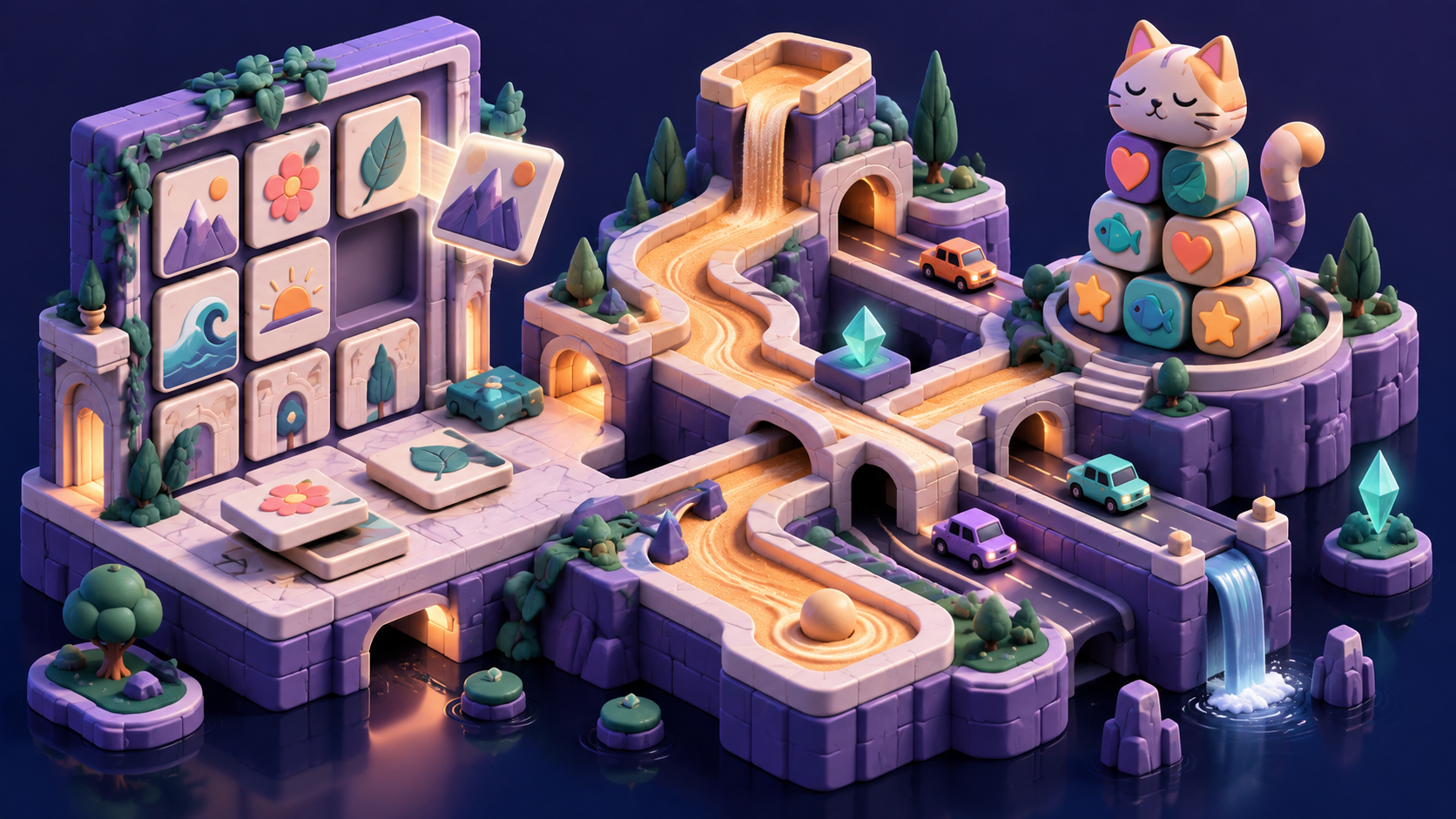
JigsFlow is unusually precise naming. “Jigs” promises image completion; “Flow” suggests sequence; “Picture Solitaire” supplies a known spatial interface. The result is not just jigsaw with a reskin. Layered picture tiles turn placement order and temporary access into the puzzle.
That matters for hybrid-casual production because the content surface is broad without making the input more complex. New pictures, silhouettes, occlusion patterns, event albums, and collection sets can all sit behind the same drag. It is hybridization as content architecture rather than a menu revealed on day two.
The cleanest compounds have one shared object. In JigsFlow, the picture tile belongs equally to jigsaw, solitaire, and collection.
The watchlist
Hole Beads
Rollic trades liquids and buses for beads, giving a familiar sorting decision a stronger sense of weight, spill, and physical reward.
Sand Traffic Fever
Flow simulation replaces vehicles without losing the traffic-jam read. The material changes the spectacle and the level-design possibilities at once.
Cat Bag: Merge Tower Defense
The title makes the full stack visible: character theme, merge economy, and defensive outcome are all part of the acquisition promise.
Tessora: Tile Sort
SayGames returns to a low-friction tile vocabulary, but the emphasis on categorization points toward more authored, themed sets.
Three signals from the shelf
- Genre labels are turning into instructions. Picture Solitaire and Merge Tower Defense do not ask the audience to decode an invented category. Two known labels describe the loop faster than feature copy could.
- Cats are carrying systems, not just tone. Categoro, Chonky Cat: Food Survivor, Escape To Love: Merge Cat, and Cat Bag attach the same approachable theme to logic, survival, narrative merge, and defense.
- Flow is escaping water. Sand Traffic Fever, Trisnake, and Swipe Sort all sell continuous movement. The pleasure comes from watching the board resolve, not only knowing the answer was correct.
Top charts: the barbell gets heavier
GameCatalog’s chart archive was still building during this period, so we will not pretend to have a complete August 29 ranking. The nearest full snapshot, captured on September 5, placed Meowdoku, Block Out, and Magic Sort at the top of US iOS free puzzle. Treat that as the market this cohort entered, not as a backdated result.
The useful read is structural: acquisition-friendly sort and block propositions crowd the free side, while long-operated match and merge games dominate revenue. Sensor Tower’s full-August ranking put Gossip Harbor, Royal Match, and Candy Crush Saga among the global revenue top five. Hybrid-casual launches sit between those poles: they need the immediate read of one and the operating depth of the other.
The most interesting new games this week do not hide the hybrid behind progression. They make the combination itself the first-session hook.
From the industry desk
Azur Games published its extended 2026 market analysis on August 25, squarely inside this report window. Its core observation—downloads falling while revenue rises across much of mobile—explains why these combinations matter. A game has to earn attention with one gesture, then justify a longer relationship without feeling like two unrelated products stitched together.
The same report says new launches account for only a small share of the current top-download cohort. That makes coherent compounds more valuable than feature piles. A name like JigsFlow sets an expectation the tutorial, content system, and creative can all fulfill.
What we’re watching next week
Whether picture-solitaire becomes a repeatable cluster, whether sand traffic is materially different from vehicle sorting after ten levels, and whether merge-defense games can keep both economies legible. Also on the edge of the watchlist: Aqua Garden Merge, where a calmer restoration fantasy may be the more durable half of the combination.
Release counts come from GameCatalog records for August 23–29, 2026. The chart section clearly distinguishes the nearest available GameCatalog snapshot from full-month third-party market data; no later ranking is presented as an August 29 position.