
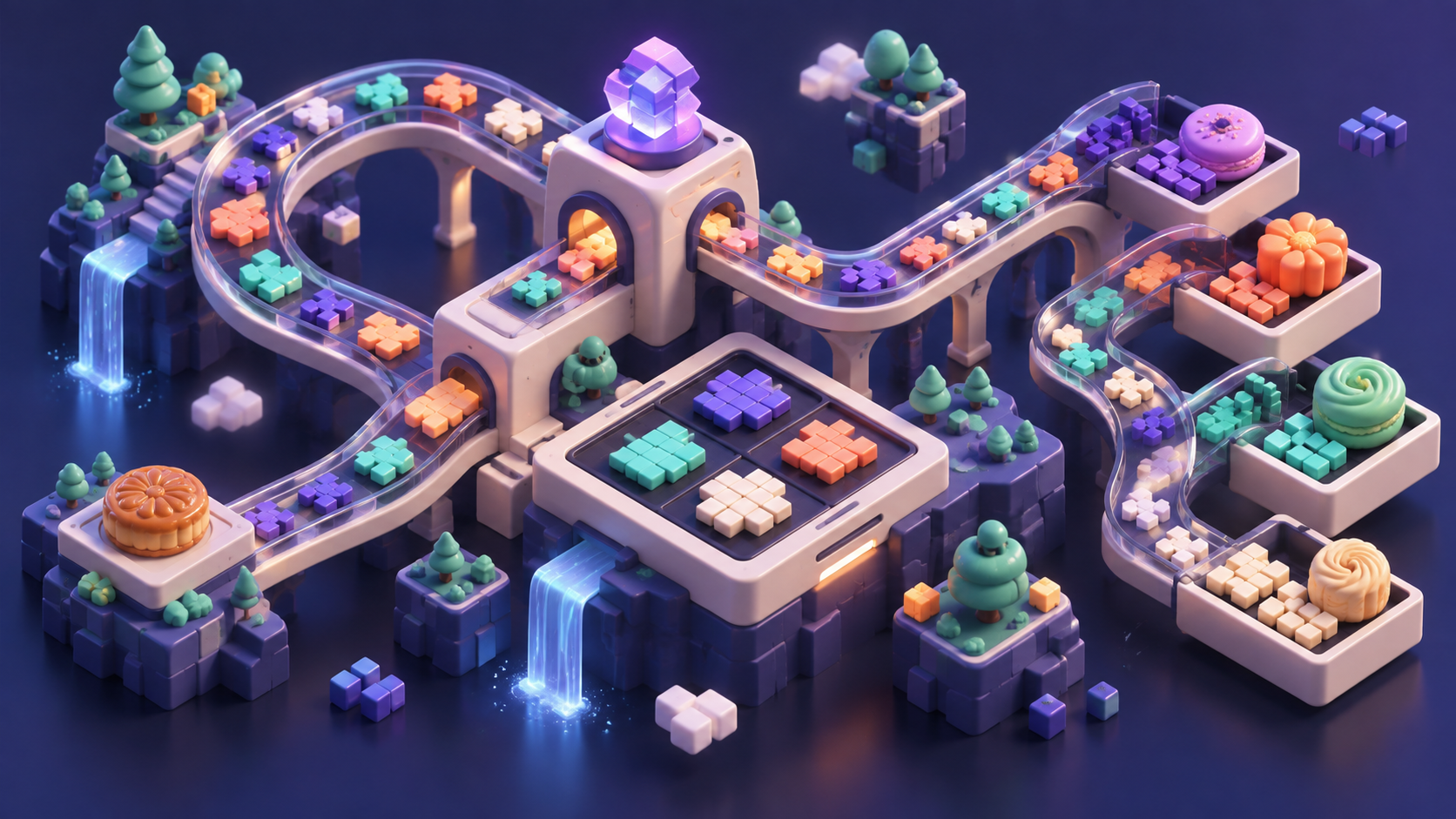
We logged 217 new games this week, 163 inside the puzzle/casual perimeter. The repetition is the signal. Pixel art appeared as an action, a reveal, and a reward; food returned as a sorting material; and looping tracks turned abstract routing into something that reads like a toy.
Game of the week: Word Loop
Word Loop earns the slot for its economy of explanation. A continuous path, a small vocabulary task, and a loop that turns the board into both input and payoff. It is a useful reminder that the best hybrid-casual hooks are often familiar ideas joined by one visually inevitable gesture.
The important word is not “word”; it is “loop.” A loop gives creative teams motion, anticipation, and a satisfying closure frame. It also offers a natural content ladder: longer routes, crossed paths, locked segments, timed challenges, and collections can arrive without changing the first-session promise.
A theme can win the click, but the object must also explain the move. This week’s strongest wrappers make the interaction clearer, not merely cuter.
The watchlist
Pixel Blast Color: Sort Puzzle
Azur puts the pixel reveal directly behind a sorting action. Completion does double duty: it clears the board and resolves the picture.
Jigsaw Stack
SayGames adds depth and occlusion to the flat jigsaw read. The stack is a small change with meaningful consequences for planning and failure.
Cookie Sort
Rollic uses instantly legible silhouettes and a high-satisfaction material. Pastry is not new; its value is how easily variety becomes content.
Bloom Logic 3D
HOMA softens spatial logic with a garden wrapper, turning solved structure into visible growth rather than a sterile cleared board.
Three signals from the shelf
- Pixels are becoming a reward surface. Pixel Blast Color, Pixel Hole, and Pixel Up use the same visual unit for different verbs. The pixel is useful because it scales from moment-to-moment feedback to collection art.
- Food remains the safest material swap. Baodoku, Cookie Sort, and Bakery Sort turn abstract grouping into objects players already understand by shape, color, and occasion.
- Loops sell motion before depth. Color Loop Sort Game and Word Loop package old decisions inside a continuous route. The loop makes a static screenshot feel kinetic.
Top charts: novelty enters through free, systems hold grossing
At the September 5 snapshot, the US iOS free puzzle chart opened with Meowdoku, Block Out, and Magic Sort. That top line is an unusually concise description of current acquisition: a recognizable theme, a high-contrast block action, and a direct sorting promise.
Grossing told the longer story. Royal Match, Gossip Harbor, Candy Crush Saga, Royal Kingdom, and Toon Blast occupied the US iOS top five. New wrappers can buy discovery; economies, content calendars, and social pressure retain the revenue positions.
The wrapper is no longer decoration around the mechanic. It is the acquisition argument, the content factory, and increasingly the reward layer.
From the industry desk
The market context supports that reading. Azur Games’ August analysis argues that mobile games are competing not only with one another but with short-form video for attention, while installs declined and revenue rose across much of the market in the first half of 2026. That raises the value of a premise understood in a single moving frame—and the cost of having nothing behind it.
AppMagic’s 2026 market landscape puts numbers behind the shift: Sort Puzzle revenue more than doubled year over year while downloads grew 41%, and Block Puzzle revenue expanded far faster than its audience. This is not simply more people discovering puzzle. It is publishers finding more product around the same legible cores.
What we’re watching next week
Whether the pixel cluster becomes a durable content system, whether food-sort launches can differentiate beyond object shape, and whether loop-based pitches generate decisions after their first satisfying animation. We are also watching Stage Smash: spectacle remains one of the few wrappers capable of making failure itself feel shareable.
Release counts come from GameCatalog records for August 30–September 5, 2026. Chart notes use the September 5 GameCatalog snapshot for the US puzzle category. Store taxonomy begins the editorial scope; mechanic classification is reviewed title by title.