
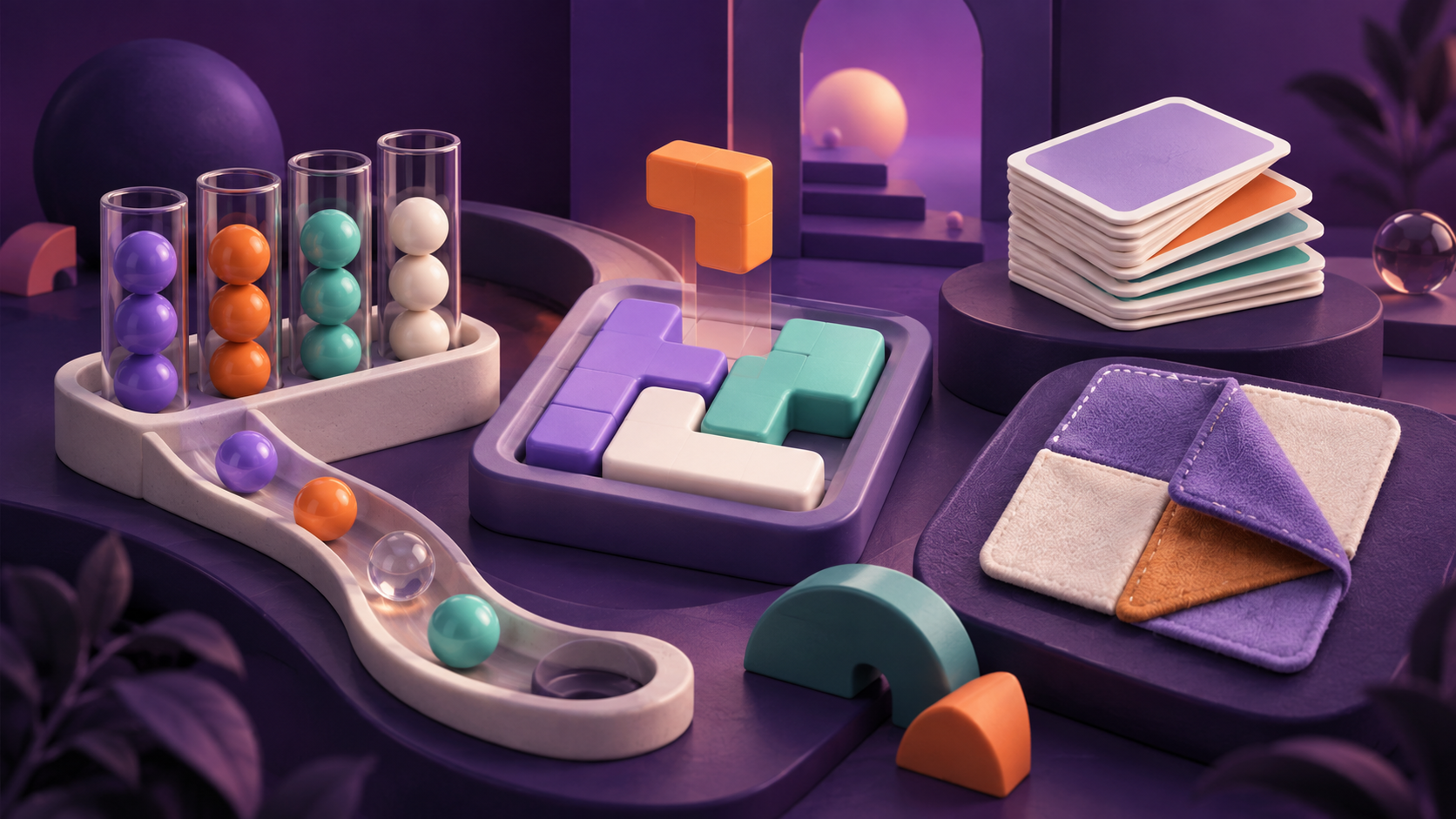
We closed the week with 170 new games. Store taxonomy places 126 of them inside the puzzle/casual perimeter. The volume is high, but variety is not the most interesting part. The same small set of legible verbs—sort, fit, fold, flow, merge—keeps returning in different materials and themes.
Game of the week: Fold Fit
Fold Fit is the week’s cleanest product thesis. Players drag the corners of a cloth, fold its two-sided material, and fit it to a silhouette. The innovation is not the word “fold” itself. It is how stretchy fabric, fixed pins, a reverse-side color, and time pressure all read in a single visual sentence.
There is a useful hybrid-casual lesson here: a new mechanic needs to communicate in an ad frame before it does in tutorial copy. Fold Fit’s fabric metaphor explains the movement while opening room for surface, color, and decoration layers. An IAP ladder from $1.99 to $99.99 at launch also suggests the game is being positioned as more than a disposable prototype.
This week’s strongest ideas do not add more objects. They give one familiar object more jobs. The cloth is the control, the rule, and the visual reward.
The watchlist
Card Sort! Puzzle
Loop Games reframes sorting through card stacks. Its value matching and stack management add a light planning layer to the familiar “put colors into tubes” model.
Card Jam Solitaire Puzzle
Zego takes a more aggressive route: triple matching, layered card layouts, limited slots, and a booster set. A 200-level update immediately after launch makes content velocity part of the product from day one.
Warstack: Merge Squad
Merge becomes a tool not just for clearing, but for squad building and battle preparation. It represents one route from a puzzle core into a broader meta game.
Hop Aboard
A Rollic release that repackages the crowded traffic-jam language around public transport. The question is less about mechanics than how much the theme can refresh CPI.
Three mechanic signals
- Sort remains a layer above genre. Water Pipe Sort, Orb Sort, Sort Kingdom, Icon Match, and Cardegory all attach different objects to the same mental model in a single week. The space is not exhausted, but changing the object is no longer differentiation on its own.
- Physics is becoming a supporting verb again. Cannon Strike, Color Splash, Animal Smash, and Royal Smash all lead with a “physics puzzle” promise. Physics is not the genre here; it is the satisfaction layer that turns every move into a tiny spectacle.
- Cards are a safe interface for puzzle. Card Sort and Card Jam borrow solitaire’s familiarity for modern sort and triple-match structures. A card face can carry effectively unlimited icons, collections, and difficulty.
Top charts: discovery moves fast, revenue moves slowly
At the September 12 close, the US iOS free puzzle chart had Meowdoku at #1, Block Out at #2, and Magic Sort at #3. Fish Sort Puzzle climbed from #65 to #13 in the same chart over the week. In Turkey, Bus Fever Party rose from #7 to #2, while Royal Match moved from #14 to #4.
The revenue side was far less mobile. The US iOS grossing top five remained Royal Match, Gossip Harbor, Candy Crush, Royal Kingdom, and Toon Blast from the start of the week. The same two leaders also held the first two positions in Turkey. Sort, traffic, and block puzzle titles can rotate rapidly through the free chart; grossing remains led by content, economy, and LiveOps machines operated over years.
That split fits the larger 2026 picture. AppMagic’s market report says Block Puzzle revenue grew roughly 12× while downloads rose 1.9×; Sort Puzzle revenue grew 2.1× alongside 41% download growth. The category is not growing through audience alone. It is growing through deeper productization.
The week’s takeaway: readability in an ad is still the entry ticket. To stay in the charts, the same idea must support content production, a controlled difficulty curve, economy, and LiveOps.
From the industry desk
The clearest corporate signal for puzzle this week was not a game announcement, but a team-building move. Lion Studios explicitly framed its new studio manager role around “hybrid puzzle” and developer partnerships across China and APAC—a sign that publishers are tightening their geographic sourcing networks around the category.
On the wider market, Azur Games’ late-August analysis carries two warnings: downloads declined in the first half while revenue grew across most genres, and new releases now represent just 2% of the current top 300 by downloads. Release volume may be high, but the barriers to distribution and staying power are rising. This column will therefore track not only “how many games launched?” but “which one can become a system operated for years?”
What we’re watching next week
We will watch for copies of Fold Fit’s material-driven control, whether Fish Sort holds its US surge, and whether the new card-sort experiments offer a real decision layer or merely a theme swap. One more early signal: cozy aesthetics are no longer a standalone theme. They are becoming the default presentation layer used to soften hard fail states.
Release and chart counts come from GameCatalog snapshots captured September 6–12, 2026. Chart coverage is limited to the US and Turkey puzzle categories: Google Play free charts cover the top 20, while App Store charts cover the top 100. Store taxonomy is the starting point for editorial scope; final mechanic classification is reviewed title by title.