
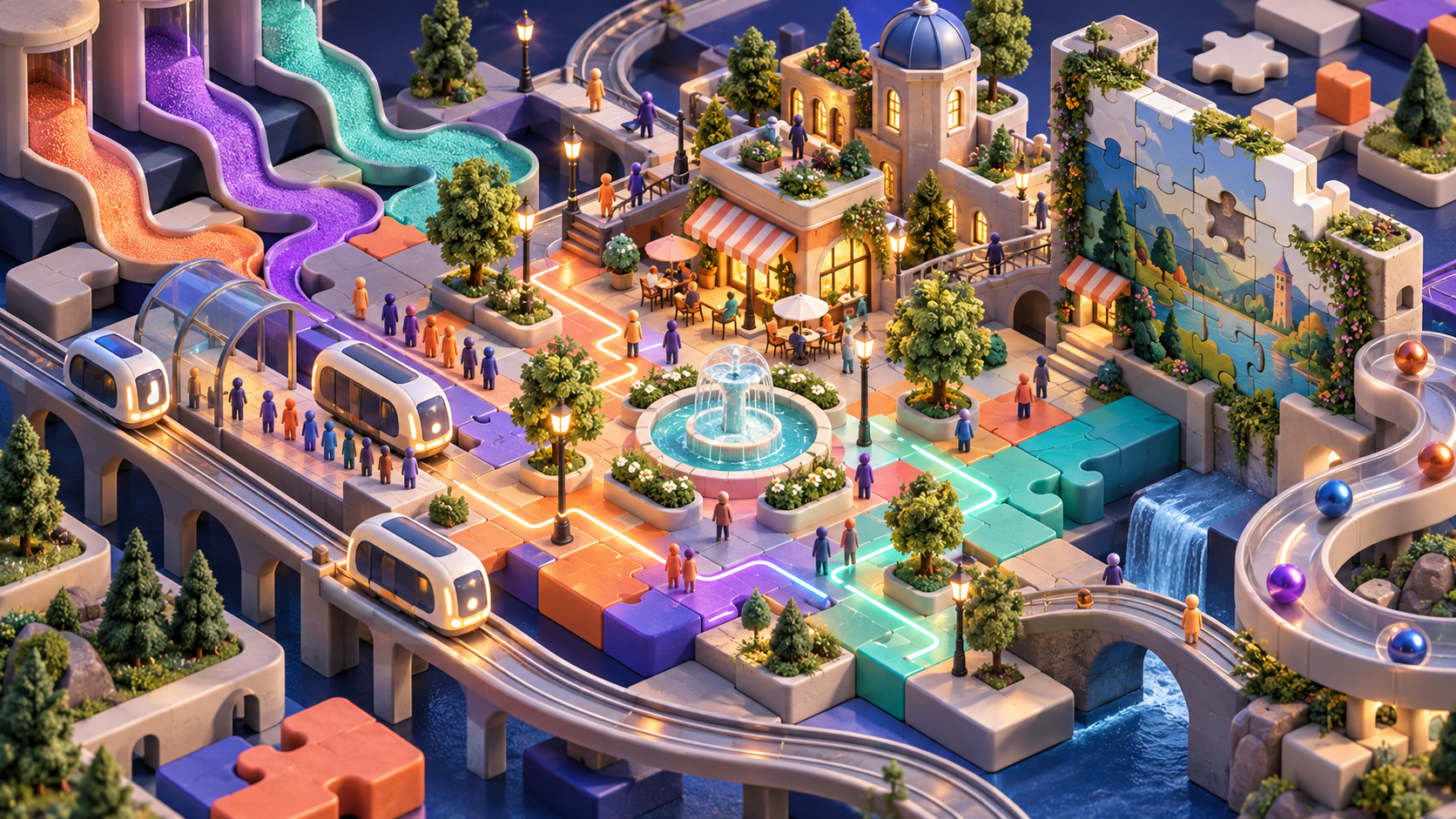
GameCatalog logged 286 new releases this week, with 224 inside the puzzle/casual perimeter. Volume returned, but the better signal was architectural: the core mechanic and the long-term fantasy are starting to occupy the same space.
Game of the week: Flow City: Sort & Build
Flow City: Sort & Build begins with a clean queue puzzle. Tap a transport pod, board citizens of the matching color, and sequence departures so the plaza does not lock. The store description promises 300 authored levels, gradually introduced blockers, daily challenges, and accessibility options. None of that is the real differentiator.
The differentiator is where each solved level goes. Build Stars repair a fountain, open a café, plant trees, and bring eight districts to life. Postcards turn those districts into albums; completed spaces become the player’s visible history. The city is not a generic reward room attached to sorting. It is the same plaza, crowd, transport, and color language seen from one level higher.
That continuity is the hybrid-casual lesson. A simple acquisition hook can support longer retention when the meta answers a question the core already asks: where are these people going, and what changes when they get there?
The best meta layer this week is not “more game.” It is a wider camera. The solved board becomes a place worth returning to.
The watchlist
Restaurant Flow
ROCKET turns inventory pressure into a dining-room system. Dishes stack on a limited tray, colored tables lock, and auto-service makes every correct sequence visibly productive.
Sandy Snakes
BREW Games makes sand part of the rule set: snakes consume matching grains, gravity exposes new routes, and every dragged body changes the remaining space.
Slide & Fit: Jigsaw Game
Voodoo-backed picture completion trades loose-piece placement for a constrained sliding board. The final image is both solution and collection-ready reward.
Marble Hit Jam
Panteon joins bank shots, timed objectives, and a ten-step merge chain. Angle selection creates the skill expression; merging controls board density.
Three signals from the shelf
- Place is becoming progression. Flow City, Restaurant Flow, Sticker Room: Little Town, and Cat Town: Merge Adventure give the player somewhere for solved levels to accumulate. A district, restaurant, room, or town communicates progress more emotionally than a stage counter.
- Material is becoming a rule set. The week included Sandy Snakes, Sandy Blocks Jam, Sand All, Sand Block Crush, and Water Blast. Sand falls, water depletes, marbles ricochet. These are not cosmetic swaps; the material tells players what can happen next.
- “Flow” now describes an outcome, not one mechanic. Flow City, Restaurant Flow, Gecko Flow, and Block World: Color Flow use the word across transport, service, movement, and color clearing. The shared promise is uninterrupted resolution.
Top charts: flow rises, grossing holds
The final retained chart snapshot in this coverage window is September 18; no September 19 snapshot was available, so the positions below are not presented as a Saturday close. In US iOS free puzzle, Block Out moved from #2 to #1 during the week, while Colony Flow climbed from #8 to #3. Loop Sort improved from #5 to #4 on US Google Play.
Turkey supplied the stronger visual-theme signal. Food Hunt: Pixel Puzzle rose from #8 to #3 on iOS, and Jewel Color Sort: Pixel Puzzle moved from #13 to #8. The free charts are still rewarding compressed propositions: one material, one verb, one readable transformation.
Grossing barely blinked. The US iOS top five on September 18 remained Royal Match, Gossip Harbor, Candy Crush Saga, Royal Kingdom, and Toon Blast. Discovery rotates around new surfaces; revenue stays with mature worlds.
The hybrid opportunity is not to hide a city behind a puzzle. It is to make every puzzle move feel like work performed on that city.
From the industry desk
A new September market sample reinforces the density visible in our release shelf. Appaloma’s block-and-sort study counted 185 active titles across 16 mechanic clusters, with 98 launched in the previous 18 months and accounting for 63% of the sample’s review pace. Its largest clusters were triple/pair matching and arrow escape, followed by pixel-color, picture-filling sort, and fit puzzles. Saturation is real, but attention is still flowing toward recent products with sharply named visual systems.
Publisher organization is following the same signal. PocketGamer.biz’s September people roundup notes Lion Studios appointing a studio manager specifically focused on hybrid puzzle and partnerships across China and APAC, while PlaySimple and MTG added a casual-division CMO. Puzzle is no longer a side lane inside broad casual portfolios; teams are being structured around sourcing and scaling it.
What we’re watching next week
We will watch whether “place as progression” spreads beyond city and restaurant wrappers, whether the sand cluster produces a repeatable hit rather than a burst of parallel tests, and whether Marble Hit Jam can keep its physics and merge objectives readable as boards become crowded. We are also tracking Category Word Swap: category completion may offer word games the same collection logic that picture puzzles already use.
Release counts come from GameCatalog records for September 13–19, 2026. Chart movement compares retained September 13 and September 18 snapshots for the US and Turkey puzzle categories; September 19 was unavailable at publication time. Store taxonomy begins the editorial scope, and mechanic classification is reviewed title by title.