
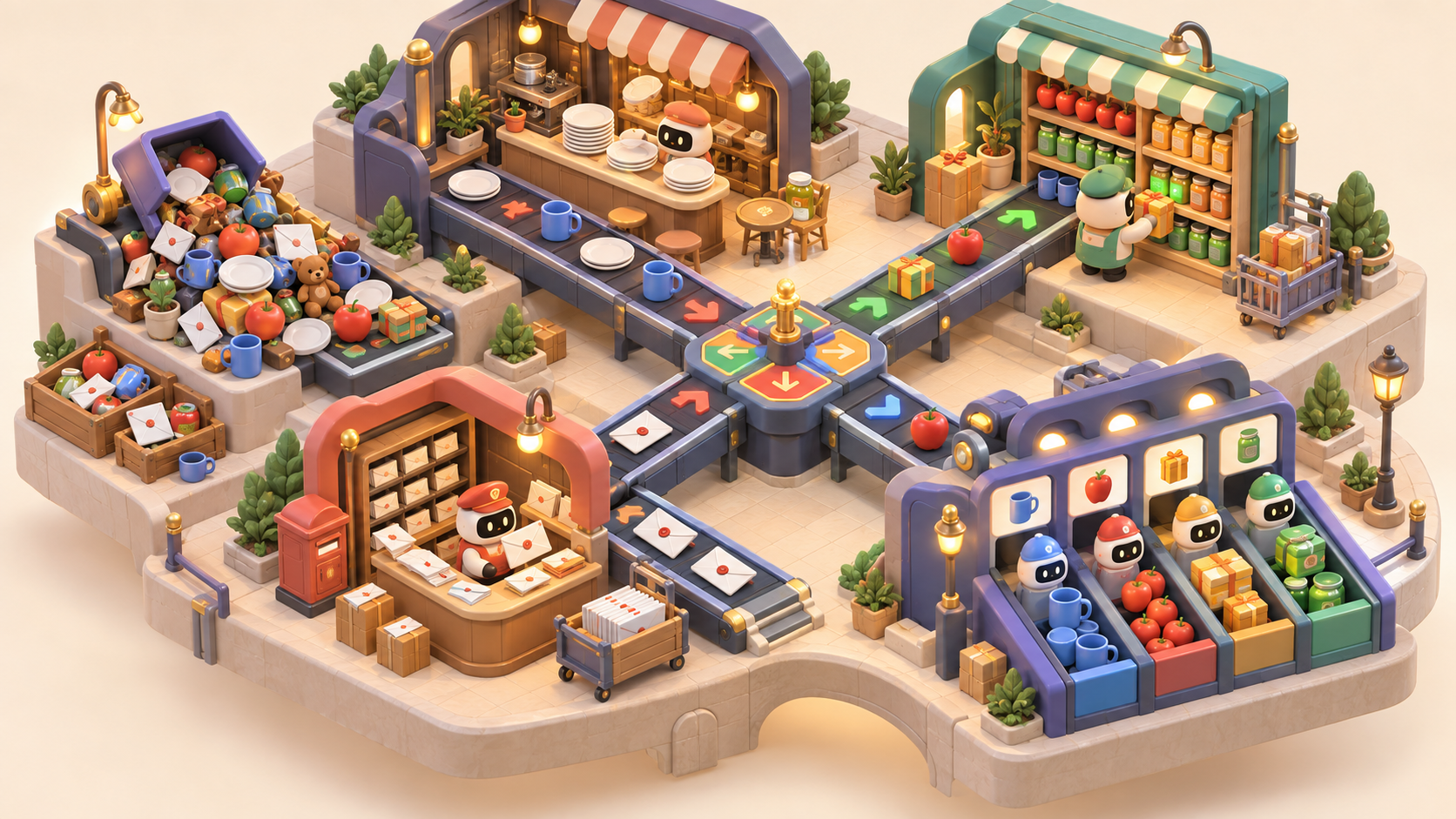
GameCatalog logged 226 new releases this week, with 170 inside the puzzle/casual perimeter. The release count was lower than last week, but the design signal was unusually consistent: sorting is being reframed as useful work, and that purpose is carrying both the tutorial and the reward.
Game of the week: Tidy Plates Word Sort Puzzle
Tidy Plates Word Sort Puzzle starts with mixed words on dirty plates. Players identify a shared category, drag matching plates together, and complete a vocabulary set before the limited move count runs out. The mechanic is immediately readable, but the framing changes what completion feels like: the table is not merely cleared; the plates become clean, polished, and neatly stacked.
TapbrainX then gives that small act somewhere to go. Solved levels award Stars for restoring a bakery and pantry, then a street café and later locations. Hidden words, frozen plates, locked obstacles, boosters, soft 3D materials, ASMR feedback, and a raccoon companion stretch the loop without breaking its central promise.
That coherence earns the slot. Category knowledge drives the decision, cleanup supplies the sensory payoff, and renovation gives the work a longer horizon. Core, presentation, and meta are describing the same activity from three distances.
A useful fantasy can teach a puzzle faster than a tooltip. We already know what a stocked shelf, delivered letter, seated guest, and clean plate should look like.
The watchlist
Cooking Blast: Match & Sort
Colored guests, limited seating, double-portion eaters, inseparable pairs, and hidden customers turn a familiar queue into restaurant operations. Sorting, merging, and match-clearing share one service flow.
Where It Belongs
HYPERLAB converts supermarket stocking into a clue puzzle. Above, beside, same row, and linked-item relationships make every placed product both an answer and new information.
Pocket Post: Cozy Sorting Game
Envelope trim, wax seals, stamps, invisible ink, and playful curses turn a one-thumb mail shift into visual deduction. Delivered letters feed neighborhood stories and a collectible stamp album.
Sort Loop
Players place Hoppers onto a conveyor, then watch them automatically collect matching items. Rescue missions, character merging, gates, and a growing base turn efficient sorting into a system to expand.
Three signals from the shelf
- Work is becoming the rulebook. Tidy Plates, Cooking Blast, Where It Belongs, and Pocket Post use familiar jobs to explain goals, failure, and feedback. The fiction reduces tutorial cost because order has a visible definition.
- Categories are becoming a puzzle primitive. Card Category Sort, Stack Slot: Category Puzzle, and Bubble Drop: Category Sort move beyond pure color matching. Meaning can now be the constraint, giving the same simple drag-and-place interface much broader content.
- Reveals are replacing clears. Jigsaw Layers exposes cards beneath completed pictures; Happy Pics Sort resolves hidden art; Gift Sort uncovers objects behind each match; and Jigstack Pictures rebuilds full canvases from layered decks. Empty space is useful, but discovery is a stronger reason to make it.
Top charts: free moves, grossing stays put
GameCatalog retained both the September 20 opening snapshot and the September 26 close for this coverage window. US iOS free puzzle kept Meowdoku at #1 and Block Out at #2. Beneath them, CubeAway moved from #4 to #3 and Brain Puzzle 3 from #11 to #6, while Colony Flow eased from #3 to #5. On US Google Play, Arrows – Puzzle Escape held #3 and Loop Sort moved from #4 to #5.
Turkey showed the larger free-chart movement. Gardenscapes climbed from #15 to #7 on iOS and Royal Match from #5 to #4. Jewel Color Sort slipped from #8 to #11, while Rotate Rings entered the retained top 100 during the week and closed at #15.
The monetization shelf was almost perfectly still. The US iOS grossing top five opened and closed with Royal Match, Gossip Harbor, Candy Crush Saga, Royal Kingdom, and Toon Blast in the same order. Turkey’s top five also finished exactly where they began. Free charts are still testing new reasons to sort; grossing continues to reward mature operating systems.
The strongest sorting pitch no longer says “put like with like.” It says who needs the result, what becomes orderly, and what the player can build from that order.
From the industry desk
The week’s release pattern sits inside a much larger commercial shift. AppMagic’s 2026 Mobile Market Landscape reports that sort-puzzle downloads grew 41% year over year while revenue increased 2.1×, making it the only large, fast-growing hybrid-puzzle segment with balanced audience and monetization growth. The important question is no longer whether sorting scales. It is which contexts can make another sort game feel authored rather than interchangeable.
Arrow puzzles show the same pressure from the other side. A genre report published by Emhance on September 23 says three arrow-puzzle titles occupied the worldwide top five mobile games by downloads in June, and cites 10% day-90 retention for the format. That scale explains the copies, but it also raises the bar: a directional core now needs stronger content, progression, or purpose to stay distinct after the first clean exit.
What we’re watching next week
We will watch whether category sorting develops enough authored logic to resist content repetition, whether Sort Loop makes automation a genuine planning layer rather than a passive payoff, and whether Cooking Blast can keep its queue readable as guest types accumulate. On the craft edge, Hangle is worth tracking: its hanging-mobile physics offer a rare form of endless puzzle depth without leaning on the dominant sort vocabulary.
Release counts come from GameCatalog records for September 20–26, 2026. Chart movement compares retained September 20 and September 26 snapshots for the US and Turkey puzzle categories. Store taxonomy begins the editorial scope, and mechanic classification is reviewed title by title.