
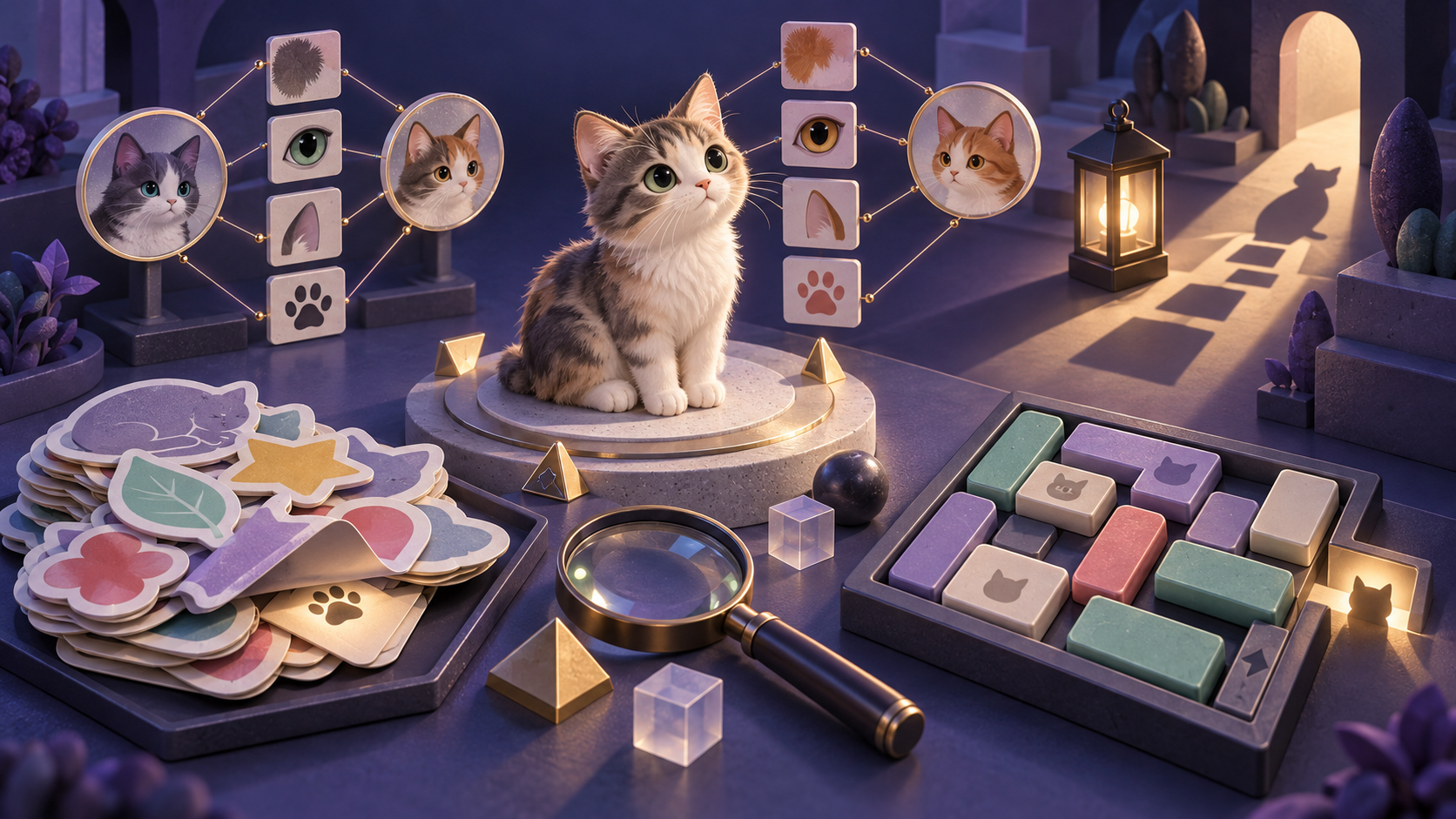
GameCatalog logged 283 new releases this week, with 215 inside the puzzle/casual perimeter. The strongest designs were not content to present an object and ask for a match. They asked the player to gather evidence: compare a kitten’s inherited traits, place suspects, read a moving shadow, or peel back a crowded surface until the decisive detail appeared.
Game of the week: Whose Kitten?
Whose Kitten? begins with a small mystery: a kitten has been left at the shelter, and its parents are somewhere in town. Coat color and pattern, eyes, ears, tail, and even the number of toes become clues. Players inspect candidates across different locations and times of day, then place a mother and father on an elimination board.
The clever move is that genetics are not decorative flavor. They are the rule system. A familiar “spot the difference” vocabulary becomes deductive because each visible trait has to make sense as inheritance. Observation produces a hypothesis; the board asks the player to commit to it.
Then the shelter closes the hybrid loop. Food, water, litter, toys, brushing, adoption letters, a photo album, and a family tree turn solved cases into care and collection. The advertised five-to-ten-minute cycle is compact, but it connects a legible puzzle to a persistent emotional space. That is exactly the kind of integration hybrid-casual design needs.
Evidence is a stronger verb than “find.” It gives every observation a consequence and makes the answer feel earned rather than merely revealed.
The watchlist
Cluedoku: Detective Puzzle
Rooms, objects, characters, and written clues convert a sudoku-like grid into casework. The theme explains why every exclusion matters: each placed suspect is an argument, not just a correct cell.
Lampion: Shadow Theater
A moving lantern redraws the walkable world because its tiny soul can travel only through shadow. Sixty handcrafted scenes, nightly challenges, verified optimal solutions, and unlimited undo give a poetic rule serious puzzle discipline.
Sticker Find
Overlapping sticker piles turn occlusion into the board. Finding cats, food, toys, and other themed objects feeds category collections, so every exposed layer is both a clue and a piece of a longer album.
Blocked In: Color Sort Puzzle
Tripledot’s narrow corridors force same-color blocks toward their exits while fixed, arrow, ice, key, and mystery pieces keep changing what counts as a viable route. The promise is familiar; the constraint set is not.
Three signals from the evidence board
- Deduction is becoming the fantasy. Whose Kitten?, Cluedoku, Hacker Puzzle: Ghost Handler, and Hidden Objects: Broken Vow all package puzzle progress as a case to prove. The fiction makes failure useful: a wrong answer is a theory that did not survive the evidence.
- Visibility is becoming a resource. Lampion redraws traversable space with light, Sticker Find hides targets under overlapping layers, and Hidden Objects Game: Find & Go turns attention into progression. These games are not only testing what players see; they are letting players change what can be seen.
- A known rule can still carry one new exception. Let’s Sort! adds hidden layers, wax seals, locked cabinets, filters, and shutters to water sorting, while Blocked In gives route pieces distinct behaviors. The core stays instantly legible, but the material around it becomes the authored content.
Top charts: the leaders held, the middle rearranged
GameCatalog retained both the September 27 opening snapshot and the October 3 close for this coverage window. US iOS free puzzle kept Meowdoku, Block Out, and Rotate Rings fixed at #1, #2, and #3. Beneath them, Magic Sort and Colony Flow each gained one place, while CubeAway moved from #4 to #6. On US Google Play, Royal Match rose from #4 to #3, Arrows – Puzzle Escape moved from #3 to #4, and Loop Sort eased from #5 to #7.
Turkey’s iOS chart moved more decisively. Rotate Rings climbed from #6 to #3, while Food Hunt: Pixel Puzzle slipped from #3 to #4. Sand Blocks: Drop Puzzle entered the retained top 100 during the week and closed at #7. The chart is rewarding instantly readable physical propositions—rings, falling sand, traffic, and pixel reveals—even when the underlying decisions differ.
The monetization shelf did not move at all. The US iOS grossing top five opened and closed with Royal Match, Gossip Harbor, Candy Crush Saga, Royal Kingdom, and Toon Blast in the same order. Turkey’s top five were equally static. Discovery is rotating through new puzzle surfaces; spending remains concentrated in established live systems.
The board is no longer only a place to act. It is a scene to read: every trait, overlap, shadow, and obstacle can become evidence.
From the industry desk
The chart movement has wider context. In Gamesforum’s September ranking based on AppMagic data, Food Hunt: Pixel Puzzle was the month’s #1 trending mobile game and Colony Flow ranked #4. Both reduce the ad-readable promise to a single visual question—what is hidden in the pixels, and where should the crowd flow—then let the live product add breadth after the hook has landed.
At the other end of the production spectrum, Mobilegamer.biz reported that Moon Active soft-launched Dream Bay, a renovation-themed merge game, across 11 European markets on Google Play. Its merge orders, storm-damaged resort, missing-grandmother mystery, and 30-day rebuild show why the hybrid conversation cannot stop at the core. Familiar mechanics are still being asked to carry authored worlds, timed arcs, and long-term narrative questions.
What we’re watching next week
We will watch whether Whose Kitten? can turn genetics into a repeatable case generator, whether Cluedoku expands the daily-logic audience through character and setting, and whether Blocked In can keep its route density readable as piece behaviors accumulate. We will also keep Dream Bay on the soft-launch board: its retention story will say more than its renovation story.
Release counts come from GameCatalog records for September 27–October 3, 2026. Chart movement compares retained September 27 and October 3 snapshots for the US and Turkey puzzle categories. Store taxonomy begins the editorial scope, and mechanic classification is reviewed title by title.