
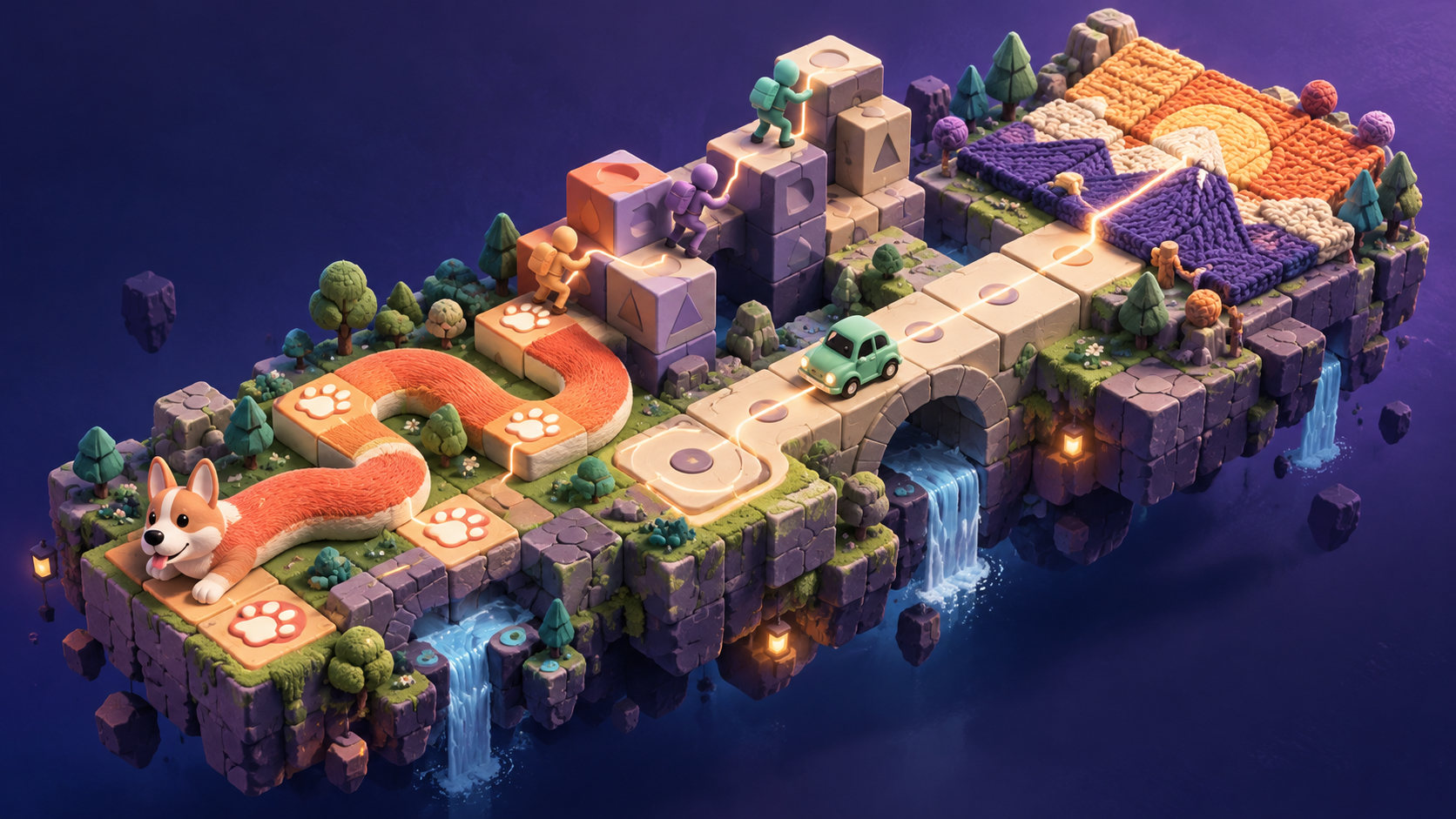
GameCatalog logged 214 new releases this week, with 154 inside the puzzle/casual perimeter. The most useful design signal was not another new verb. It was a tighter relationship between piece and outcome. Instead of placing an abstract line and then watching a character use it, the character became the line. Instead of completing a grid and receiving a picture, the grid became the material of the picture. Representation stopped decorating the rule and started carrying it.
Game of the week: Corgi Flow: Color Line Puzzle
Corgi Flow: Color Line Puzzle turns a familiar connect-the-colors board into a spatial object puzzle. Each corgi has two draggable ends, each end belongs on a matching paw print, and the dog’s body occupies every cell between them. The route is not a stroke laid over the board. It has length, bends, a head, a tail, and enough physical presence to trap the next route.
That change makes order visible. Moving one corgi can open a corridor, close a corner, or force another body to be rerouted. Different lengths and obstacles deepen the packing problem while the timer adds hybrid-casual urgency. Hints, a timer freeze, and an obstacle-removing hammer soften the fail state without changing the central read: clear every animal without turning the grid into a kennel jam.
The theme earns its space because it improves memory. Players do not need to remember which anonymous line can be moved from either end; they remember the long orange corgi whose tail is blocking the blue dog. Character is not a reward wrapped around the puzzle. Character is the geometry.
The fastest way to make an abstract puzzle feel authored is not always to add a story. Sometimes it is enough to make the piece explain why it behaves that way.
The watchlist
Climb the Wall!
Shaped blocks carry climbing holds. Players slide them into a continuous ascent, then watch tiny climbers test the route. The traversal is both the proof and the payoff.
Connect Roads: Puzzle Game
Row and column counts define how many cells contain road, but the finished grid must also form one unbroken route. A car drives the answer, turning deduction into infrastructure.
Shape & Stitch
Players draw allowed block patterns onto numbered regions of a woven canvas. Spatial coverage and embroidery share the same gesture, so solving the board is literally making the textile.
Shuffle Factory
Mixed cards unload onto a limited conveyor, then recollect into color-matched boxes. Surprise boxes, linked groups, and locked slots make the production line itself the puzzle state.
Three signals along the route
- The object is teaching the rule. In Corgi Flow, a long body explains occupancy. In Shape & Stitch, woven cells explain coverage. In Sea Lights, lighthouses make row-and-column illumination intuitive. The theme reduces the distance between seeing a piece and understanding its consequence.
- Completion has a witness. Climbers ascend the route in Climb the Wall!; a car drives the finished deduction in Connect Roads; bees uncover the layered flower picture in Buzzy Flow. The board does not simply disappear. Something uses what the player built.
- Capacity remains the quiet difficulty knob. Crowd Jam asks players to match hollow-block capacity to the remaining crowd, Shuffle Factory can choke its conveyor, and Brick Party! layers incoming shapes over limited box space. Familiar color logic becomes strategic when storage is scarce.
Top charts: the leaders held, the middle rotated
GameCatalog’s retained October 11 and October 17 snapshots show an unusually stable US top line. On iOS free puzzle, Meowdoku, Block Out, and Magic Sort held #1 through #3. Rotate Rings rose from #5 to #4 and Block Blast from #7 to #5, while CubeAway fell from #4 to #8. Sand Blocks made the clearest top-20 move, climbing from #19 to #11.
US Google Play was even steadier: its first seven positions closed exactly where they opened, led by Block Blast, Magic Sort, Gossip Harbor, and Royal Match. Match Factory entered the retained top 20 at #17; the opening snapshot only preserves Android’s top 20, so its earlier rank cannot be stated more precisely.
Türkiye split the difference. Its Android top seven also remained unchanged, with Block Blast, Royal Match, and Royal Kingdom holding the first three positions. On iOS, the top three held while Gardenscapes climbed from #8 to #4, Hotel Legacy from #16 to #5, and Word Tiles from #17 to #6. Rotate Rings moved the other way, from #6 to #22. US iOS grossing kept its top five in the same order; Türkiye kept its top four, with Royal Kingdom advancing from #7 to #5.
When the answer becomes a road, a body, or a fabric, the completion animation is no longer decoration. It is verification.
From the industry desk
The week’s most relevant business signal came from Türkiye. Flow Games confirmed $49 million in cumulative funding from Tencent, Makers Fund, Arcadia Gaming Partners, and Ludus Ventures, alongside more than 23 million worldwide downloads for its physics puzzler Smash Fest! since May. The lesson is larger than one cannon game: a legible action, expressive physics, and ad-friendly spectacle can still create the scale that attracts serious growth capital.
The broader market is less forgiving. Aream & Co’s Q3 update, reported by PocketGamer.biz on October 12, put mobile game IAP at $19.6 billion, down 7% year over year, with downloads down 10% and no 2026 release yet breaking into the top-grossing chart. That context matches this week’s own grossing snapshot: incumbent systems barely moved. For a new hybrid-casual puzzle, novelty has to win the install, but the route after the install still needs the depth of an incumbent.
What we’re watching next week
We will watch whether Corgi Flow can keep its character-shaped paths readable as boards tighten, whether Connect Roads can stretch one-solution deduction from 4×4 starters to 9×9 boards without losing its calm rhythm, and whether Shape & Stitch can make restricted block forms feel like craft rather than constraint. Shuffle Factory is the commercial counterpoint: its conveyor, hidden colors, linked boxes, and locks already read like a scalable obstacle ladder.
Release counts come from GameCatalog records for October 11–17, 2026. Chart movement compares retained October 11 and October 17 snapshots for the US and Türkiye puzzle categories. Google Play history retains the top 20, so moves beyond that boundary are described without invented ranks. Store taxonomy begins the editorial scope, and mechanic classification is reviewed title by title.