
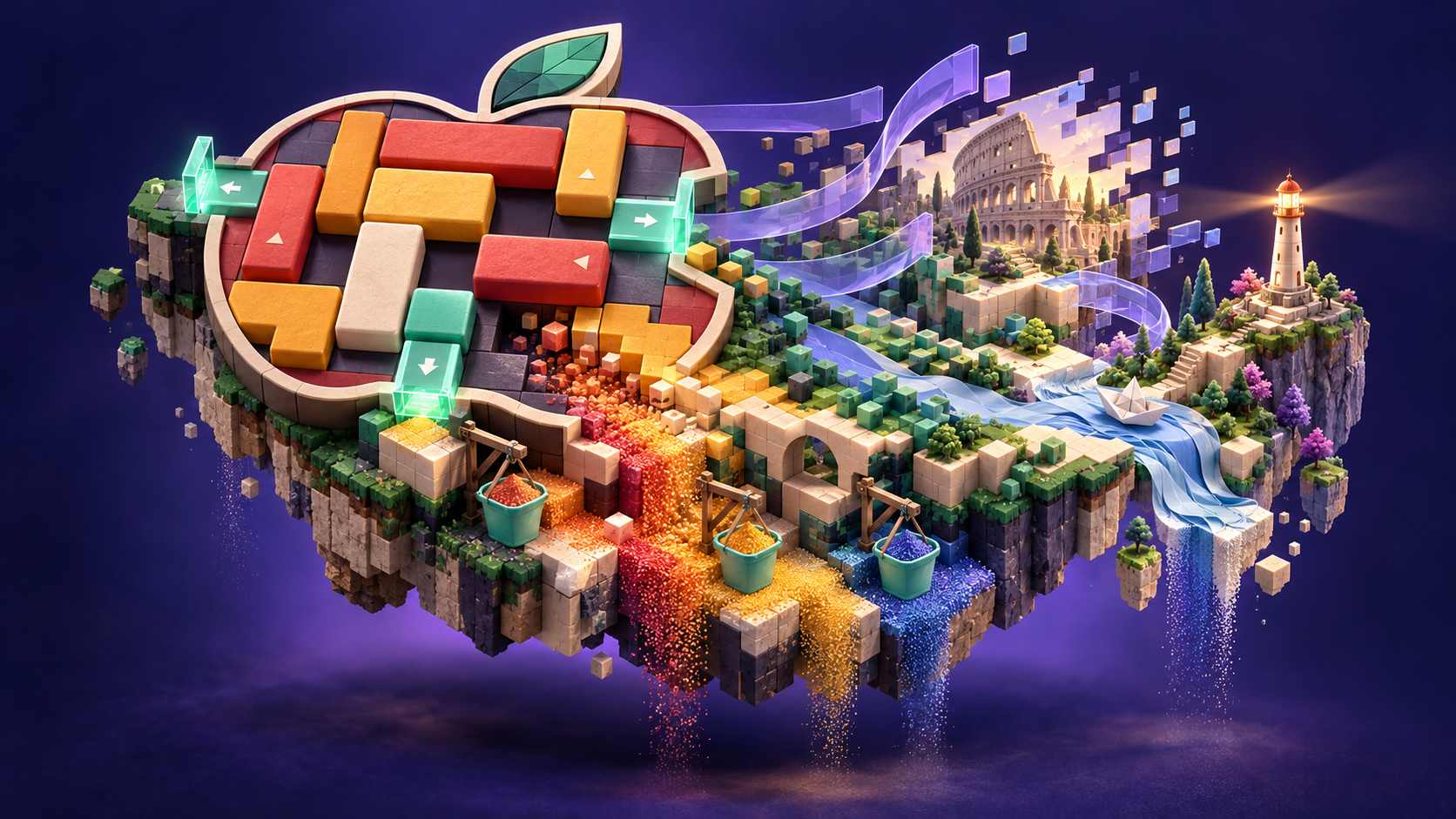
GameCatalog logged 276 new releases this week, with 201 inside the puzzle/casual perimeter. The strongest ideas shared a useful inversion: the picture was not a prize placed after the mechanic. It was the board, the clue, and sometimes the thing being dismantled. Apples held sliding blocks, landscapes hid beneath arrow mazes, and pixel art collapsed into sand. The image stopped saying “well done” and started telling the player what kind of thinking the level required.
Game of the week: Chroma Gate: Shape Puzzles
Chroma Gate: Shape Puzzles builds every post-tutorial board inside a distinct silhouette: an apple, key, zipper, arch, or one of 250 other pictures. Colored bricks slide until they hit an obstacle and leave only through matching gates. Clear the wrong brick first and the next one loses its route. Before the player touches anything, the outline has already given the level an identity.
The production method is as interesting as the presentation. Bricks are injected backward along the paths they will later use to escape, allowing the silhouette and solution to be generated together. Each board is then checked while being built, checked again as a shipped level file, and played through by a solver using simulated touches. Time budgets are based on measured search difficulty rather than raw brick count.
Five modifiers—ice, split bricks, chains, portals, and walls—share the same compact board. The first nine stages introduce them one at a time; later boards combine them without getting physically larger. Color-blind symbols make every gate readable, and the product avoids lives, energy, accounts, and forced tutorial interruptions. The shape supplies novelty while the rule set stays disciplined.
A themed silhouette is more than decoration when it changes the lanes, corners, and exits. The picture can be the level-design constraint.
The watchlist
Paper Track: logic puzzle
Clues define one continuous creek across the grid. Players mark water and land, then a folded paper boat sails the completed route to a lighthouse. Daily challenges add a light competitive layer without changing the calm core.
Sandy Trails
A drawn cut divides pixel artwork into physics-driven sand sections. Color buckets circle a conveyor, collect matching grains, and return to limited holding slots if they cannot finish.
Pixel Pull: Color Magnet
Numbered magnets loop around layered pixel pictures, pulling reachable cubes of their own color. Unfinished magnets consume waiting space, so every satisfying cleanup pass creates the next capacity decision.
Unknit: Cozy Rope Art Puzzle
Scattered buttons and colored links form a provable network. Correctly rebuilt triangles stitch themselves into a larger image, turning rope untangling into a one-solution deduction puzzle.
Three signals inside the frame
- The silhouette is doing onboarding work. Chroma Gate announces each board as an object before it becomes a traffic problem; Arrow Trail promises a landmark under every layered maze; and Sandy Trails starts with a recognizable pixel scene. Players understand what completion means before they understand every rule.
- Destruction is becoming visible progress. Pixel Pull removes a picture cube by cube, Ant Feast! has a colony carry away voxel blocks, and Sandy Trails dissolves artwork grain by grain. Clearing is not an abstract percentage; the subject itself gets smaller.
- Proof is replacing luck in the pitch. Chroma Gate describes three layers of solvability checks, Paper Track asks for the only continuous route, and Unknit promises exactly one solution derived from its link network. “You can reason this out” is becoming a product benefit.
Top charts: two sudden arrivals
GameCatalog’s retained October 18 and October 24 snapshots captured a dramatic Android move in the US: Rotate Rings closed at #1 after beginning outside the retained Google Play top 20. That boundary is all the opening data supports; it would be wrong to invent a precise starting rank. Block Blast, Magic Sort, and Gossip Harbor each moved down one place to #2, #3, and #4. Royal Kingdom rose from #7 to #5.
US iOS kept its top three unchanged: Meowdoku, Block Out, and Magic Sort. Below them, Sand Blocks climbed from #8 to #4, Word Tiles from #14 to #10, and Woodoku Blast from #69 to #17. The iOS archive retains the full top 100, so those longer moves are directly observed rather than inferred.
Türkiye supplied the second arrival. Meowdoku jumped from #66 to #1 on iOS, pushing Block Blast and Bus Fever Party to #2 and #3. Hotel Legacy fell from #5 to #13. Türkiye’s Android top eight did not change at all, while the US iOS grossing top seven and Türkiye iOS grossing top 12 also closed exactly where they opened.
A reveal is strongest when it changes how the player reads the next move—not only what they see after the last one.
From the industry desk
The week’s chart jump came with outside scale evidence. PocketGamer.biz reported on October 21 that Rotate Rings had passed 11.1 million downloads, rising from #199 by worldwide monthly downloads in September to #6 in October with 11 days still left. That speed explains why the title could appear above the Android retention boundary and finish the week at #1: the chart move is part of a broader acquisition surge, not an isolated daily spike.
Its runway still matters more than its opening velocity. AppMagic’s October 22 study of 158 games released in 2026 that reached $1 million in tracked IAP found 26 qualifying puzzle titles. Their median time to the milestone was 126 days, none arrived inside 30 days, and their median lifetime revenue was $4.3 million—the highest among genres with at least five games in the sample. Hybrid-casual puzzle can scale quickly in installs; meaningful IAP still appears to reward a longer product horizon.
What we’re watching next week
We will watch whether Chroma Gate can keep 250 silhouettes mechanically distinct rather than merely picturesque, whether Sandy Trails can turn its cut line into a strategic tool instead of a visual flourish, and whether Unknit can make network deduction legible as its portraits become denser. Pixel Pull is the hybrid-casual test: repeated magnet laps and limited waiting slots give a familiar pixel-cleanup fantasy a measurable failure pressure.
Release counts come from GameCatalog records for October 18–24, 2026. Chart movement compares retained October 18 and October 24 snapshots for the US and Türkiye puzzle categories. Google Play history retains the top 20, while iOS retains the top 100; moves beyond those boundaries are described without invented ranks. Store taxonomy begins the editorial scope, and mechanic classification is reviewed title by title.