
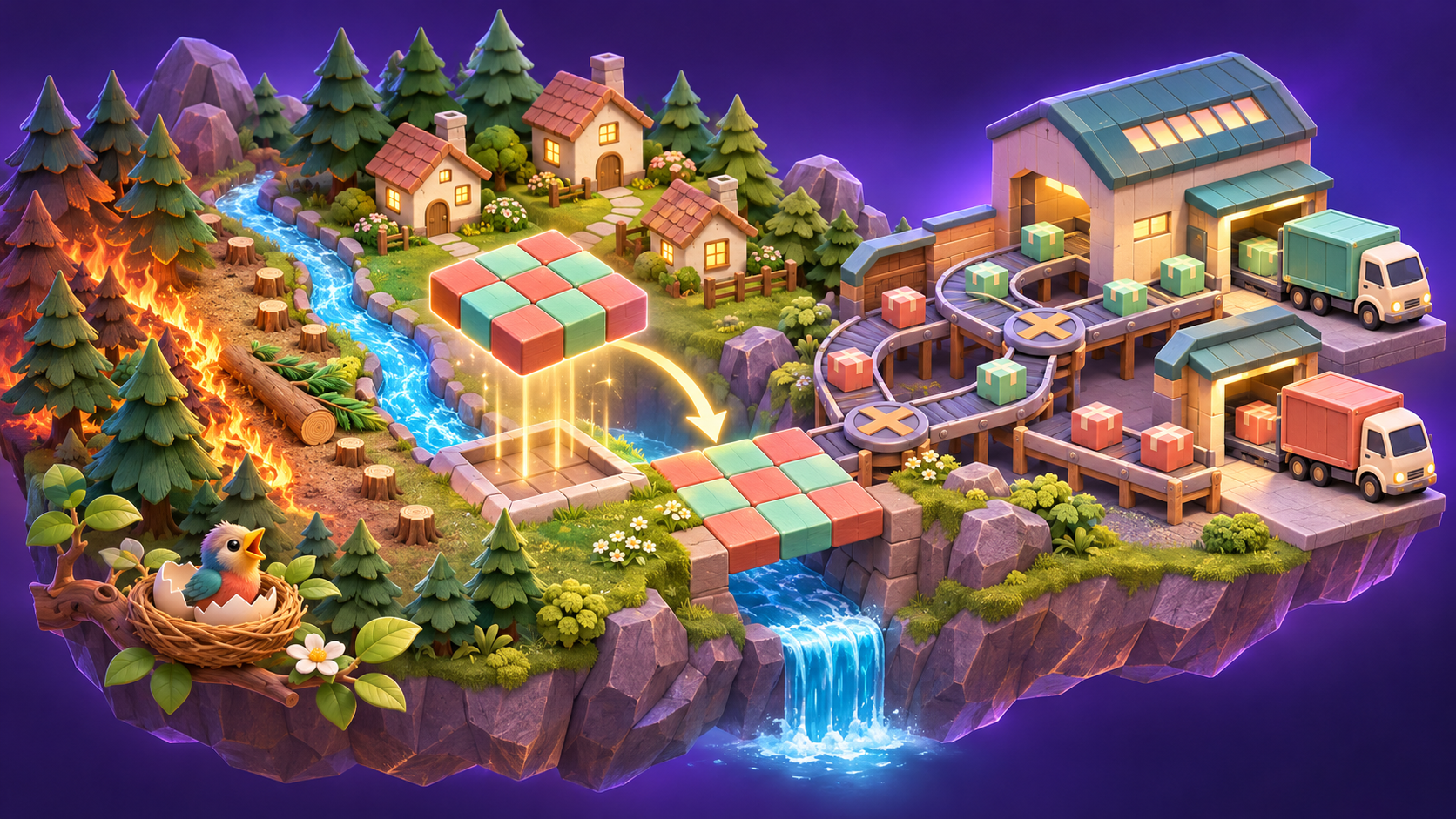
GameCatalog logged 363 new releases this week, with 275 inside the puzzle/casual perimeter. The familiar verbs were everywhere—46 titles used “sort,” 19 used “jam,” and 14 used “arrow”—but the stronger designs were less interested in the tap than in what happened after it. A tree fell into a chosen lane. Fire spread diagonally. Parcels committed to a junction. A finished square became a new movable object. The input stayed simple; the consequence became the spectacle.
Game of the week: Firebreak: Forest Puzzle
Firebreak: Forest Puzzle gives the player a small woodland, a move budget, and several cottages that must still be standing when the flames finish spreading. Nothing burns while the plan is being made. After the final move, the fire advances automatically—including diagonally—and the board reveals whether the player understood the whole system rather than the last interaction.
The object set turns preparation into a chain of physical consequences. Ordinary trees can be cut to open gaps. Tall pines fall as logs, so direction matters. Boulders roll through trees and can be moved again. Water gates release streams into channels, protecting every tree they reach. Across 240 levels, each new object changes what a move can do without changing the fundamental promise: study first, commit once, then watch the plan run.
The hybrid layer is restrained but complete. Wins restore eight landscapes in a living valley; a pinecone challenge asks players to preserve marked trees and stacks a multiplier up to ×10 against 50 simulated rivals. There is a daily forest after six campaign wins, but no planning timer, lives, energy, account, ads, or in-app purchases. The result is a useful reminder that “hybrid” can describe the depth of the return loop, not only the density of monetisation.
Delayed resolution turns a tiny input into a readable story. The player does not merely clear a tile; they make a prediction and then watch the board prove it right or wrong.
The watchlist
Make It Square!
Players fill compact 3×3 grids with one color, but completion does not remove the square. It turns the finished grid into a piece that can be dragged elsewhere, making the reward for one sub-problem the tool for the next.
Cargo Tangle: Conveyor Puzzle
Rotating a junction commits colored parcels to branching belts, loops, hold gates, and timed feeds. The warehouse keeps moving after the tap, so route planning and observation share the same 20-level board set.
Bird & Egg: Logic Puzzles
A binary-grid rule set—equal symbols per row, no three alike in a line, linked same/different clues—feeds a 180-bird collection across 12 habitats. Deduction produces hatching energy, then coins grow birdlings into adults.
Picture Patches: Logic Puzzle
Shikaku-style rectangles partition the grid around numbered clues. Every valid region fills another patch of a hidden picture, so the proof and the reveal arrive together instead of living in separate layers.
Three signals after the input
- Resolution is becoming a second phase. Firebreak waits until the plan is complete before spreading the flames; Cargo Tangle lets parcels test every rotated junction; and Pocket Links 3D adds shifting pockets, moving barriers, and timed traps after its basic hold-link-release gesture. The board gets a turn.
- Completed objects are staying useful. In Make It Square!, a solved 3×3 region becomes a movable block. Assemble Painting makes three ordered pictures complete one level and then preserves them inside a customizable gallery. Bird & Egg converts a finished grid into collection progress. Completion is becoming inventory.
- Theme is carrying the consequence. A generic hazard would not make Firebreak legible in the same way as flame approaching cottages. Boxes and trucks make a wrong route visible in Cargo Tangle; a hatching bird gives binary logic an emotional endpoint in Bird & Egg. The fiction explains why the system must keep moving.
Top charts: an arrow exits, the grid holds
GameCatalog’s retained snapshots for this coverage window run from October 26 through October 29; October 25, 30, and 31 are not present, so this section describes only the movement we can directly observe. On US Android, Rotate Rings moved from #1 to outside the retained top 20. Block Blast rose from #2 to #1, while Sand Blocks entered the retained list at #15 from somewhere below #20. No precise opening rank is available.
US iOS was steadier at the top: Meowdoku, Block Out, Magic Sort, Sand Blocks, and Block Blast held the top five. Below them, CubeAway rose from #9 to #6, Colorever from #25 to #16, and Jigsaw Drop from #22 to #19.
Türkiye’s Android top six did not move, and only Tile Club and Arrows swapped #7 and #8. On iOS, Food Hunt rose from #4 to #3, Gardenscapes from #6 to #4, and Hollywood Merge from #37 to #20. Word Tiles fell from #5 to #15. The US iOS grossing top five and Türkiye iOS grossing top 12 were unchanged across the same four-day window.
A good consequence is not extra animation. It is the part of the rule that happens after the player has committed.
From the industry desk
The US Android reversal lands beside a broader genre signal. Mobilegamer.biz reported on October 28, citing AppMagic, that arrow-puzzle downloads peaked in June and had cooled by autumn, while the subgenre’s IAP revenue reached a new high in September. The split matters: the acquisition wave can recede while a smaller set of products continues learning how to monetize the retained audience.
That monetisation is also becoming part of the public product conversation. Mobilegamer.biz documented a viral October 27 debate around a creator’s unverified claims about dynamic difficulty, player profiling, and ad timing in major games; the publishers had not responded when the story was published. The allegations should not be treated as established facts. The attention around them is the signal: invisible systems are now being judged as part of the puzzle experience, not merely as back-office monetisation.
What we’re watching next week
We will watch whether Firebreak can keep its post-move simulation readable when pines, rocks, water, and preservation challenges overlap; whether Make It Square! can build enough variety from its completed-square state change; and whether Cargo Tangle can turn a 20-level proof of concept into a durable content system. Bird & Egg is the hybrid test: its collection is unusually legible, but 180 birds will need a reward cadence that keeps the logic—not the hatch timer—at the center.
Release counts come from GameCatalog records for October 25–31, 2026. Chart movement compares retained October 26 and October 29 snapshots for the US and Türkiye puzzle categories because no snapshots are stored for October 25, 30, or 31. Google Play history retains the top 20, while iOS retains the top 100; moves beyond those boundaries are described without invented ranks. Store taxonomy begins the editorial scope, and mechanic classification is reviewed title by title.