
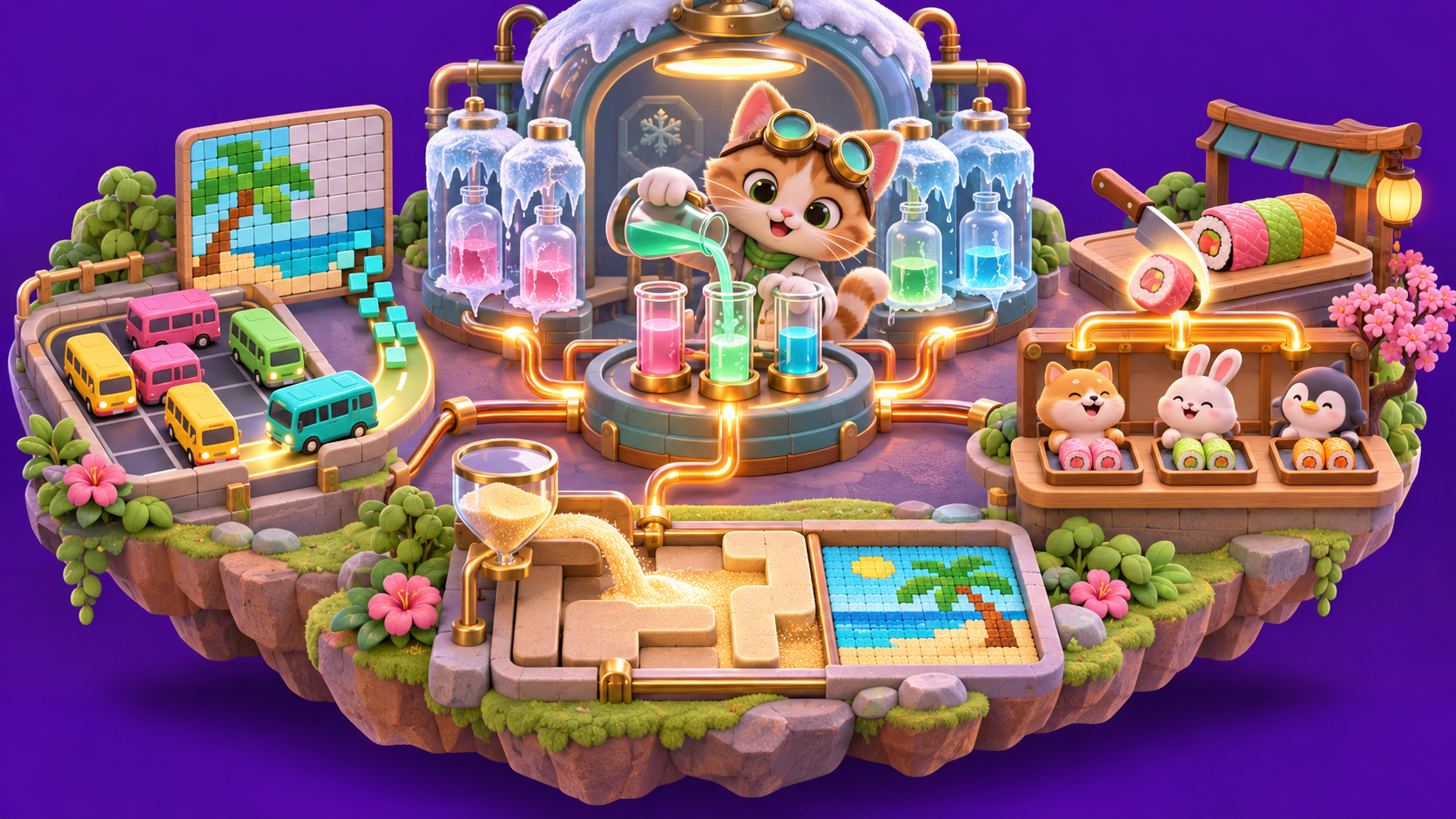
GameCatalog logged 226 new releases this week, with 153 inside the puzzle/casual perimeter. “Sort” appeared in 23 titles, “jam” in 12, and “block” in nine. The useful change was not another noun on the shelf. It was the amount of work a single gesture could perform: arrange the pieces and unlock the board, relieve congestion and complete the image, serve the customer and free the holding area.
Game of the week: Kitty Tube Sort: Cryo Lab
Kitty Tube Sort: Cryo Lab starts with a familiar promise: pour colored liquid until every tube contains one color. Then it gives every pour a second responsibility. A move anywhere in the laboratory melts one layer of ice from its frozen bottles. The player is therefore sorting the visible state while also advancing a global unlock clock.
That small rule bends the whole level grammar. A technically useful pour can be valuable because it separates a color, because it removes an ice layer, or because it does both at once. Covered question-mark bottles postpone information; a teapot accepts only purple liquid; and frozen tubes turn move order into a resource without introducing a separate energy bar. The obstacle is not adjacent to the core. It is powered by it.
The store build surrounds that loop with chapters, boss stages, daily quests, optional rewarded ads, and Turkish as well as English localisation. But the hybridisation is already complete before any of those systems arrive. One gesture changes two readable states, and both changes help explain why the next gesture matters.
The best secondary system does not ask for a second control. It makes the move the player already understands feel more consequential.
The watchlist
Pixel Bus Out
Choosing a bus opens the parking grid and sends its passengers into matching pixels, gradually revealing a hidden picture. Frozen, hidden, and connected vehicles complicate the route, while limited waiting slots make every traffic move part of a second capacity puzzle.
Happy Trays: Sushi Sort Puzzle
A tap selects the top plate; a knife cuts its rolls; each slice travels to the matching customer tray. The same choice clears a layered stack and fulfils an order, with a limited bar converting poor sequencing into visible pressure.
Sifty Sands: No Timer
Players slide shaped blocks beneath falling sand, match each color to its container, and clear the layer to expose a pixel-art scene. Filling the mold is simultaneously the logic problem, the clear condition, and the reveal animation.
Block Word Sort
Word cards first sort into categories, then completed groups combine into broader concepts: states can become a country, for example. A correct set is not removed from play; it becomes the piece required by the next level of classification.
Three signals from double-duty design
- The secondary clock is moving into the core. Ice in Kitty Tube Sort melts when the player pours, not after a level or through a separate currency. The countdown becomes spatial and immediate: every ordinary action also brings locked capacity closer.
- Completion is becoming continuous. Pixel Bus Out does not wait for the traffic board to end before showing the picture. Sifty Sands reveals its scene layer by layer. Progress arrives inside the solve, giving short sessions more than one payoff point.
- Holding areas are doing narrative work. The waiting slots in Pixel Bus Out are commuters, while the bar in Happy Trays is a service queue. Capacity pressure reads less like an abstract fail condition when the pieces visibly have somewhere to go and someone to serve.
Top charts: US wordplay, Türkiye buses
GameCatalog retained daily chart snapshots from November 8 through November 13, but no November 14 snapshot. The movements below compare Sunday’s opening with Friday’s last retained reading; they are not presented as a Saturday close. Google Play history retains only the top 20, while iOS retains the top 100.
On US Google Play, Cutie Sort: Kitten Games entered the retained top 20 at #20, from somewhere below that boundary. Tile Explorer moved from #12 to #10, while Sand Blocks edged from #10 to #9. Yarn Loop, #6 on November 8, was outside the retained top 20 by November 13; the data does not support a more precise closing rank.
US iOS supplied the week’s cleanest new ascent. Merge Bubbles Word Game rose from #42 to #19, while Mahjong Clash moved from #34 to #20 and Cube Smash from #30 to #22. In the transport cluster, Bus Traffic Fever climbed from #9 to #5.
Türkiye’s iOS list was more directional. Royal Kingdom rose from #8 to #2, Bus Fever Party from #6 to #3, and Bus Traffic Fever from #30 to #16. Family Farm Merge advanced from #26 to #11. Türkiye Google Play was comparatively quiet: Tic Tac Toe moved one place, from #12 to #11.
A second outcome is most persuasive when it explains the move—not when it merely rewards the move afterward.
From the industry desk
King made the same principle visible at live-ops scale. Its Game On Season for Candy Crush Saga, running November 9–December 6, layers 81 collectible pins across nine sets onto level play and adds Arcade Leagues where green candies become leaderboard points. The core match is still doing its familiar work, but selected pieces and completed levels now feed collection and competition at the same time. It is a mature expression of this week’s release-level idea: the retention system begins inside the move.
The economic design around those layers also gained a new policy signal. On November 11, the European Commission presented its proposal for a Digital Fairness Act; the accompanying questions and answers specifically say it would clarify rules for paid virtual currencies and digital subscriptions. This is a proposal, not a rule already in force. For hybrid-casual teams, the design lesson is nevertheless immediate: if a move advances two systems, the value and cost of both should remain legible—especially when the second system reaches into currency, progression, or spending.
What we’re watching next week
We will watch whether Kitty Tube Sort can keep ice pressure strategic after the surprise wears off; whether Pixel Bus Out can make its completed pictures worth the traffic work; and whether Happy Trays can grow 500 levels without turning service into visual noise. Block Word Sort is the deepest systems question: if completed categories continue becoming meaningful pieces, word sorting may have found a scalable hierarchy rather than another skin.
Release counts come from GameCatalog records for November 8–14, 2026. Chart movement compares retained November 8 and November 13 snapshots for the US and Türkiye puzzle categories; no November 14 snapshot is stored. Google Play history retains the top 20, while iOS retains the top 100, so positions beyond those boundaries are described without invented ranks. Store taxonomy begins the editorial scope, and mechanic classification is reviewed title by title.